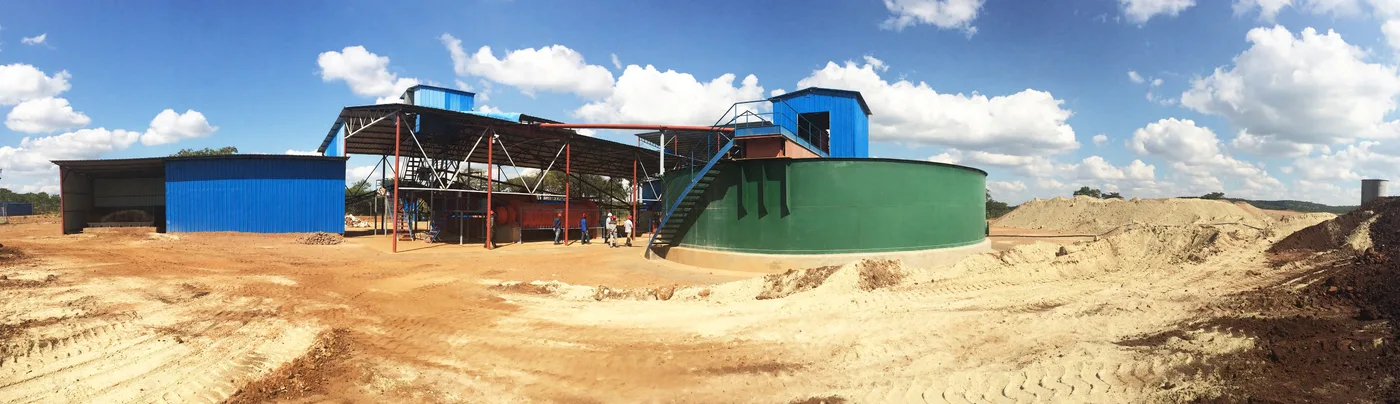
Zimbabwe: 2 Mt/a spodumene, built in 364 days and then operated
Dense medium separation solved a flotation problem, and the operation contract turned a commissioned plant into one running above design throughput.
Project at a glance
| Item | Detail |
|---|---|
| Location | Zimbabwe |
| Capacity | 2 Mt/a spodumene concentrator |
| Scope | EPC+M+O, cost plus profit sharing |
| Schedule | 364 days from contract signature to production |
| Mill throughput | Above design capacity by 7.6% |
| Equipment utilisation | 95.7% |
| Concentrate grade | Stable above 5.5% |
| Recovery | Raised from 59.5% to 69% |
| Incremental output | Around 70,000 t of concentrate per year |
What the project involved
The metallurgical problem came first. Petalite in this orebody could not be separated effectively by flotation, so the test programme moved to dense medium separation: heavy liquid tests with tetrabromoethane in the laboratory, then pilot verification with ferrosilicon medium.
The flowsheet that came out of that work runs crushing and screening, dense medium separation to recover petalite, grinding and classification, gravity recovery of tantalum and niobium, desliming, mica flotation and finally spodumene flotation.
Delivery was EPC+M+O under a cost plus profit sharing model, which aligns the contractor with the plant's performance after handover rather than at handover. The operating results reported for the project are the reason that structure matters: mill throughput above design, equipment utilisation at 95.7%, and recovery lifted by nearly ten percentage points.
When a dense medium route fits your ore, and when it does not
The separation used here is not a default setting. It earns its place on three conditions, and fails plainly when one is missing.
Ask one question before any flowsheet talk: which lithium mineral are you actually mining? The USGS deposit model for lithium-caesium-tantalum pegmatites names three principal ore minerals, spodumene, petalite and lepidolite, and they don't behave alike in a plant. Petalite is normally compositionally pure. Spodumene, on the same account, is not, and that difference lands on the back end of the plant rather than the front. The specification note further down works through what it costs. Same deposit type. Different plant.
Three things have to be true for a dense medium route
- A real density contrast between the lithium mineral and the quartz, feldspar and mica around it. Without contrast there's no separation, however tidy the sink-float curve looks on paper.
- Liberation at coarse size. If your valuable grains only come free in the fine fraction, they leave with the light product and nothing downstream gets them back cheaply.
- A manageable fines and clay load. Weathered near-surface pegmatite and clay-rich feed both foul a medium circuit and drag medium into the product streams.
The alternatives, and what each asks of you
| Route | Fits when | What it costs you |
|---|---|---|
| Whole-ore flotation | Liberation is fine, the lithium mineral floats cleanly, and there is no usable density split | More grinding energy, and a reagent regime that is sensitive to slimes and to process water chemistry |
| Dense medium pre-concentration ahead of flotation | Coarse liberation on part of the feed and a fine tail that still carries value | Two circuits to build, staff and control, plus real discipline on medium recovery |
| Magnetic separation | Iron-bearing minerals report to the concentrate and your buyer has set an iron ceiling — see the specification note below | It removes an impurity; it will not raise Li2O grade on its own, so it sits alongside another route rather than instead of one |
| Gravity recovery of tantalum and niobium | Columbite-tantalite reports to the ore, which the USGS pegmatite model treats as the normal tantalum source in this deposit class | Extra stages that only pay back if the by-product sits in your offtake agreement |
Test work settles this argument, not preference. Heavy liquid work answers whether the density split exists at all; pilot work with a real ferrosilicon medium answers whether it survives at scale, with medium losses, wear and a feed that changes hour to hour. Both steps ran here before the flowsheet was fixed. Skipping the second one is a cheap decision that gets expensive during ramp-up, and it's the reason our test work stage sits ahead of design rather than beside it.
What a two-mineral lithium ore adds to the enquiry
Spodumene and petalite in the same rock changes what the sample has to be, before it changes what the plant has to be.
The generic list, sample mass by test type, assay suites, chain of custody and export permits, sits on our test work page and applies to any ore. What follows applies only when spodumene and petalite occur together, as they do here.
The two lithium minerals sit on opposite sides of the gangue
Measured densities put petalite at 2.412 to 2.422 and spodumene at 3.03 to 3.23. The rock around them lies between the two: quartz at 2.65, albite 2.60 to 2.65, microcline 2.54 to 2.57. One cut density cannot collect both lithium minerals, because they report to opposite products of the same bath. The flowsheet on this project takes petalite out in the dense medium circuit and leaves spodumene to flotation further down the line. Build the sink-float programme against that shape: cuts on both sides of the feldspar band, and a lithium assay on every fraction, floats included. Assay the sink alone and a large part of the lithium in your ore reads as tailings.
Mica sits between the feldspars and spodumene
Muscovite measures 2.77 to 2.88, just under spodumene and above every feldspar in that band. It is the one common gangue mineral in this rock that does not sit with quartz and the feldspars, so a density figure quoted for “the gangue” describes it badly. On this flowsheet the micas are taken out by flotation, before spodumene flotation, and that is why a sample stripped of its micas tells you nothing about the load that stage will carry. Send it with the micas intact, and include the weathered domains where mica and clay travel together, because those domains decide how much fines load the medium circuit will carry.
Ship it coarse, and ship enough of it
A dense medium test can only be run on the size range the plant will treat. Crush the sample to a laboratory pulp before shipping and the coarse separation question can no longer be asked; what is left is a flotation sample, and the flowsheet gets chosen by default rather than by test. Send material in the size range that comes off primary crushing, and send enough of it that heavy liquid splits at several cut densities still leave a charge for pilot work on ferrosilicon medium.
Settle the by-products before the flowsheet, not after
Columbite-tantalite is the normal tantalum host in this deposit class, and the USGS gives tantalite-Mn a specific gravity as high as 8.1 against cassiterite at 6.5 to 7.0. Those densities sit far outside any cut made for a lithium mineral, and the same report describes tantalum recovery as staged gravity separation after crushing to sand size, yielding a primary concentrate of roughly 17 percent Ta2O5 that is then processed further. Say at enquiry stage whether tantalum and niobium belong in your offtake. Adding those stages later means reopening the grinding and classification line they hang from.
The iron ceiling is a market question before it is a plant question
This is the one specification that separates the two lithium minerals commercially. The USGS notes that some spodumene can contain as much as a few weight percent iron, that this impurity must be removed in order to achieve ceramic grade concentrates, and that the removal is typically done by early magnetic separation with late stage soda ash additions. Petalite, on the same account, is exceedingly pure and can provide a high quality ceramic concentrate relatively easily. Two lithium minerals in one orebody, two different back ends, and the mineral split in your sample decides which of them you are building. Note the scope of that statement: it is written about ceramic grade, so a battery-chain buyer sets the ceiling that binds you and you cannot read it off the USGS. The USGS quotes Australian spodumene against a 6% lithium oxide benchmark, with batteries at 88% of global lithium end use and ceramics a smaller share fed by mineral concentrates used directly. Get the specification from your buyer in writing before engineering starts: lithium oxide, the iron ceiling, moisture, size.
Cost plus profit sharing, measured against a fixed price to handover
The scope letters are settled elsewhere. What matters on this project is what the buyer trades.
Which letters mean what is set out on EPC turnkey, and where operation attaches to delivery on contract mining and operation. This plant was delivered as EPC+M+O under cost plus profit sharing, so the question worth answering here is narrower: measured against a fixed price that ends at handover, what does that structure actually move?
Who pays to learn the medium circuit
A dense medium plant carries an operating cost line a flotation plant doesn't have: the medium itself. Ferrosilicon leaves the circuit with both products, across the drain and rinse screens, through whatever the magnetic separators fail to recover, and through corrosion in the sump water. Cut density holds only as well as the densifier and the loop that trims it. Wear on pumps, cyclones and screens shows up first as drift in the cut and only later as a maintenance ticket. None of that comes out of a manual. It is learned in operation rather than in commissioning, and it is paid in medium consumed and concentrate lost. What the delivery model settles is whose balance sheet the tuition lands on. A fixed price that ends at handover leaves all of it with you, because after handover there is no other party. An operating contract puts it into the operator's fee and shared-profit line — but only as far as your reimbursable-cost definitions push it there, which is the next paragraph's whole subject.
Cost plus is an open book, and open books need definitions
Against a lump sum you give up the single number you can hold one party to. What comes back is visibility, and visibility is only worth buying if the terms are written before mobilisation. Which costs are reimbursable and which sit inside the fee: reagents, grinding media, ferrosilicon make-up, liners, rotating spares, rotation of expatriate staff. Ferrosilicon make-up is the line to argue hardest over on a dense medium plant, because it is the one consumable that a tuning decision moves directly, and a reimbursable label on it hands the learning cost straight back to you. What counts as profit before any of it is shared, and who reconciles that figure. Whether the shared measure is concentrate tonnes, contained lithium, or revenue at the buyer's assay, because those three don't move together once grade slips. And how a change to cut density or grind size gets approved, since a shared-profit term gives the operator a direct interest in a setting that consumes your resource.
The exit is part of what you're buying
What accumulates on a plant like this is not the hardware. It is the record: cut density against product assay by ore domain, medium consumption against feed clay content, reagent additions on the water the plant actually recycles, and a local crew that can hold a density loop unaided. Put in writing that all of it returns with the plant, in a form your own people can open. The general handback checklist, improvement ownership included, sits on the operation page. What is specific to a lithium plant is the density-against-recovery curve for your own ore. It won't exist anywhere except in the operator's shift data, and nothing on an equipment list substitutes for it.
Write the KPI schedule with all three terms
Revenue is availability times throughput times recovery. Three measures are on record for this project: equipment utilisation, mill throughput against design, and recovery. A KPI schedule that names only tonnes milled rewards a plant for running hard on bad feed. Write yours the same way, with us or with anyone else. Not sure which model fits? Say so in the enquiry. It's a better starting point than a wrong acronym.
Sources
External references for the industry context on this page. Project figures come from our own project brochures.
USGS Mineral Commodity Summaries 2026: LithiumThe 6% lithium oxide benchmark used to price Australian spodumene, batteries at 88% of global lithium end use, and mineral concentrates used directly in ceramics and glass.
USGS SIR 2010-5070-O: Mineral-Deposit Model for Lithium-Cesium-Tantalum PegmatitesSpodumene, petalite and lepidolite as the principal lithium ore minerals; petalite normally compositionally pure while spodumene commonly takes up ferric iron, an impurity that can complicate refining and diminish the value of the mineral for uses in ceramics; iron removal to ceramic grade by early magnetic separation and late stage soda ash; columbite-tantalite as the tantalum source, tantalite-Mn specific gravity as high as 8.1 and cassiterite 6.5 to 7.0, with staged gravity separation after crushing to sand size producing a primary concentrate of roughly 17 percent Ta2O5.
Handbook of Mineralogy: Petalite (Mineral Data Publishing)Measured density of petalite, 2.412 to 2.422.
Handbook of Mineralogy: Spodumene (Mineral Data Publishing)Measured density of spodumene, 3.03 to 3.23, which places it above the quartz, feldspar and mica band and on the opposite side of it from petalite.
Handbook of Mineralogy: Quartz (Mineral Data Publishing)Measured density of quartz, 2.65.
Handbook of Mineralogy: Albite (Mineral Data Publishing)Measured density of albite, 2.60 to 2.65.
Handbook of Mineralogy: Microcline (Mineral Data Publishing)Measured density of microcline, 2.54 to 2.57.
Handbook of Mineralogy: Muscovite (Mineral Data Publishing)Measured density of muscovite, 2.77 to 2.88, which places it above the feldspar band and below spodumene.
Send us the ore, the tonnage target and the site conditions. We reply with a scoped proposal.