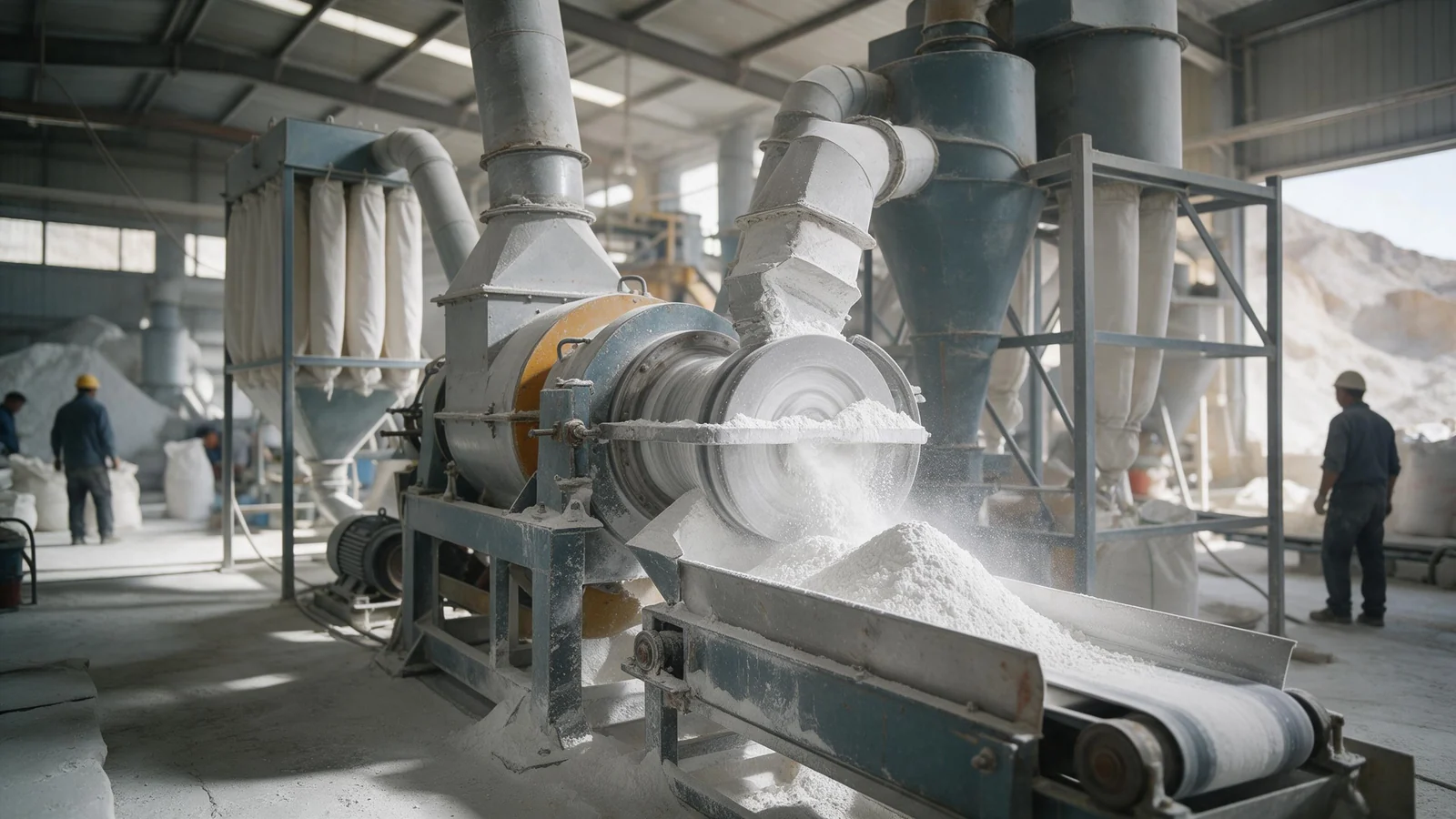
Talc Processing: Grinding, Flotation and Whiteness
Talc processing is an exercise in protecting lamellar structure while chasing two numbers: fineness and whiteness.
Header image: illustrative, not a photograph of a specific project.
Say a mine owner asks how talc processing should be designed before a single sample goes to the lab. That's the right question. Talc is soft, platy, hydrophobic and chemically inert. Its value depends on two numbers: fineness and whiteness. And here's the thing most people miss: both are set by the orebody before any circuit decision is made.
Talc ore characteristics that drive process design
You can't select equipment from a brochure until you know what the vein gives you. Talc is a hydrated magnesium silicate, formula Mg3Si4O10(OH)2. Mohs hardness of 1. That means it scratches with a fingernail. The softness is why dry grinding can preserve lamellar structure, but it also means the ore generates fines fast. Associated minerals matter more than the talc itself. Dolomite, magnesite and chlorite commonly sit next to the talc. Quartz and iron oxides are the ones that destroy whiteness. The USGS definition notes talc commonly forms by hydrothermal alteration of magnesium-rich ultramafic rocks and by low-grade thermal metamorphism of siliceous rocks. The USGS talc statistics page tracks supply, demand and trade flows, which helps you see where product grades are heading. The Talc Resources of the United States report says genetic features determine a large part of the physical and chemical characteristics of the deposit. Know the gangue before you write a single equipment specification. A talc lens with almost no iron-bearing gangue can be a high-brightness product after simple dry milling. The same orebody ten metres away with chlorite veining might need flotation and acid washing. Selective mining becomes an economic decision, not a processing detail.
Selective mining and ore pre-concentration
Selective extraction is the cheapest upgrade you'll ever get. Open-pit selective extraction, I mean. If the mine plan can leave the grey chloritic zones in the pit wall, the plant sees a cleaner feed. Hand sorting is still used in some deposits. Optical colour sorting does the same job at higher throughput. A colour sorter can reject dark particles before they enter the grinding circuit. That protects the mill from a gangue load it doesn't need to break. Ore blending is the other side of the same coin: a consistent blend feeds a stable classifier and a stable product brightness. You'll rarely get a perfect talc seam, so pre-concentration and blending are what make downstream grinding predictable. Sounds obvious, doesn't it? Yet plenty of plants skip it.
Crushing and primary grinding for talc
Crushing talc is not about liberation in the traditional sense. You're trying to reduce run-of-mine material without destroying the platelet shape. A jaw crusher works as a primary for large blocks. Many talc plants go straight to a hammer crusher because the ore is so soft. Moisture is the real enemy at this stage. Wet talc packs and clogs screens, so most circuits keep the feed dry. Primary grinding then takes two common paths. A ball mill can produce a broad size range with high throughput but risks delaminating the platelets if the charge is wrong. A Raymond mill, a type of vertical roller mill, applies less impact and more attrition, which suits a platy mineral. Test both on your ore. Feed size into the mill, top size out, and moisture are the three variables that drive the selection.
Fine grinding, classification, and whiteness control
Fine grinding is where the product specification gets made. Jet mills and vertical roller mills dominate ultra-fine talc production. A jet mill uses particle-on-particle impact with no grinding media. Contamination drops. The product stays bright. A vertical roller mill dries, grinds and classifies in one unit, which suits high-tonnage feed but adds a little iron wear. Air classifiers cut the product at a precise top size. You set the classifier rotor speed and airflow, then measure the d50 and the top cut on every shift. That's the fineness side.
Whiteness is specified separately but anchored to the same feed. You report brightness against a barium sulphate standard, often on a Hunter or ISO scale. A buyer might ask for a d50 of 7 micrometres and a brightness of 92. Both numbers are meaningless without the test method and the moisture content. Why? Because a different instrument gives a different number. That's why a coherent product specification states fineness as a particle size distribution, not a single value, and whiteness as a brightness value on a named instrument. Surface treatment with silane or stearic acid comes later, for polymer compatibility. It doesn't fix a whiteness problem.
Purification: flotation, magnetic separation, and acid washing
Your talc contains dolomite or magnesite? Flotation is the standard route to remove carbonates. A reverse or direct flotation circuit conditions the pulp with an amine or fatty acid collector, then floats the carbonate away. Talc is naturally hydrophobic, so often you float the talc and depress the gangue. Magnetic separation targets iron-bearing minerals such as magnetite, biotite or chlorite, depending on their susceptibility. Acid washing with hydrochloric or sulphuric acid dissolves carbonate and some iron oxide but adds water treatment and corrosion costs. You justify acid washing only if the target market demands very high brightness and very low acid-soluble content. For a standard filler grade, flotation and dry magnetic separation might be enough. The decision is economic, not chemical.
Dry vs wet processing: choosing the right route
Dry processing works when the ore is naturally high brightness and low in carbonate. No water treatment. Less energy for drying. It suits markets that tolerate a small amount of iron. Wet processing is chosen when the ore needs flotation to remove carbonates or silicates and when the product must be dispersed for surface treatment. The table below lays out the trade-offs.
| Decision factor | Dry route | Wet route |
|---|---|---|
| Ore grade | High brightness, low gangue | Low grade, needs flotation |
| Water and energy | No process water, less drying | Water for flotation, bigger drying load |
| Product spec | Coarse to medium fineness, moderate whiteness | Ultra-fine, high whiteness, coated grades |
| Capital cost | Lower | Higher, but justified by premium product |
You don't pick dry or wet based on a preference. You pick it because of the ore's response to a bench flotation test. If the ore floats cleanly and the whiteness jumps, wet processing earns its keep. If not, dry milling and classification are the leaner flow path. The full range of plant solutions is listed on the solutions page.
From testwork to plant delivery: an EPC perspective
No one should quote a talc flowsheet without first putting a core sample through a proper metallurgical test programme. That means mineralogy, chemical assay, Bond work index, flotation or magnetic separation tests, and a pilot run if the project is large. A laboratory result from a one-kilogram sample is not a plant design. You need continuous piloting on a representative composite before you commit to equipment sizes. That's where an EPC contractor's test laboratory becomes useful. A well-equipped metallurgical laboratory should be able to handle the characterisation work, including mineralogy, chemical assay, Bond work index testing, and flotation or magnetic separation tests. The laboratory's accreditation and throughput are less important than its ability to produce reliable, reproducible data on your specific ore.
Once the testwork sets the flowsheet, the plant design follows the same sequence for any mineral: ore characterisation, then mass balance, then equipment selection, then layout. A modular approach can shorten the field schedule, as discussed in modular mineral processing plant options. Commissioning is where the product specification gets proven. You run the plant on your own ore, measure fineness and brightness every four hours, and adjust the classifier and magnetic separator until the product sheet holds steady. That handover, not the punch list, is the real deliverable. Ready to start bench-scale testing? Use the contact page to request a proposal.
Frequently asked questions
What is talc processing and how does it work?
Talc processing is the sequence of unit operations that converts run-of-mine talc ore into a product with a controlled particle size distribution and brightness. It starts with selective mining or sorting to reject gangue, then dry or wet grinding to reduce particle size, classification to control top size, and optionally flotation, magnetic separation or acid washing to improve whiteness. The exact route depends on the orebody and the target application, not on a standard flowsheet.
What are the main methods for processing talc?
The main methods are dry milling for naturally bright ores, wet milling with flotation for low-grade or carbonate-rich ores, and dry classification with jet mills for ultra-fine products. Magnetic separation removes iron-bearing minerals, and acid washing is reserved for high-purity applications. A test programme on your ore, not a catalogue, determines which method applies.
How is talc whiteness and fineness specified?
Fineness is specified as a particle size distribution, usually the d50 and a top cut such as d97 or d98, measured by laser diffraction. Whiteness is specified as a brightness value on a defined scale, often ISO or Hunter, against a barium sulphate standard. Both must state the test method, moisture content and surface treatment because those factors change the reported numbers. A supplier should provide the instrument and method before you compare two products.
What equipment is used in talc processing plants?
Common equipment families include jaw crushers or hammer crushers for primary size reduction, ball mills and Raymond mills for intermediate grinding, jet mills and vertical roller mills for ultra-fine grinding, air classifiers for particle size control, flotation cells, magnetic separators and acid washing systems. The specific type and size come from testwork on the ore, not from a generic list.
Request a proposal for your ore
What to send for a useful reply
- Head assays and, if you have them, a phase or mineralogy report
- Target throughput in t/d and the product you want to sell
- Project stage: exploration, feasibility, financing or expansion
- Site basics: country, power, water and access
Not ready to share data yet? Read the EPC turnkey delivery page first.