Niobium Processing: Gravity First, Then Magnetics
Say a mine owner asks how to set up a tantalum-niobium plant. The first answer isn't a machine; it's a mineralogy question.
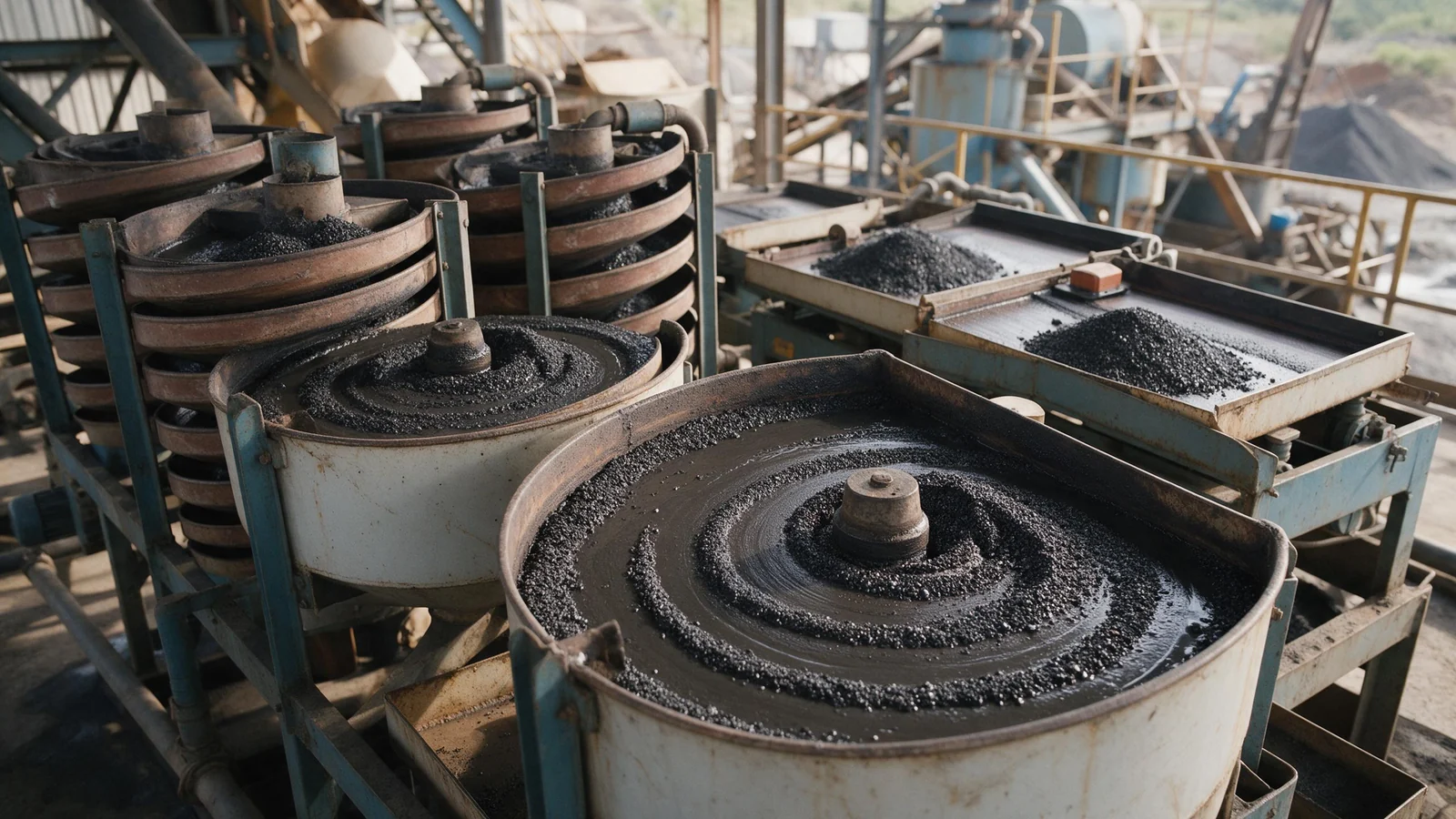
Header image: illustrative, not a photograph of a specific project.
Say a mine owner asks about niobium processing. You don't hand them a machine list. You hand them a mineralogy report. There's no universal flowsheet for coltan or pyrochlore ores. Ore type, grain size, clay content, gangue associations. All of it decides the route. Accept that first. Tantalum primarily occurs in tantalite, which may be found in carbonatites, alkaline granite-syenite complexes, and lithium-cesium-tantalum (LCT) pegmatites. That's from the USGS data catalog. Niobium in pyrochlore sits in carbonatite complexes, often with apatite, magnetite, and carbonate gangue. These host rocks behave very differently in a plant.
How tantalum-niobium ores behave and why processing starts with mineralogy
Ta-Nb minerals are dense. Tantalite and columbite have specific gravities well above most silicates. That's why gravity separation comes first. But they're brittle too. Overgrinding creates slimes. Those slimes report to tails or blind downstream equipment. A flowsheet that chases liberation too far will lose metal. Feed grades are often far below one per cent combined Ta₂O₅ plus Nb₂O₅. Early gangue rejection isn't a luxury. It's survival. You can't afford to float or leach the whole ore feed.
Mineralogy and particle-size distribution decide whether gravity, magnetic, electrostatic, or flotation routes apply. A coltan ore from a pegmatite might respond to gravity alone up to a point. A fine-grained pyrochlore in carbonatite will need flotation. Same metal pair, different host, different plant. Sounds obvious, but plenty of projects skip the mineralogy. They pay for it later.
Ore washing, crushing, and stage grinding for Ta-Nb feed preparation
Weathered and clay-rich ores need washing before anything else. Clays coat particles, blind screens, and turn a clean gravity feed into a sticky mess. A scrubber or trommel with high-pressure water is often the first unit operation. Stage grinding follows. Rod mills are common here. They produce a narrow size distribution and less slimes than a ball mill in open circuit. You want to liberate without pulverising. Screens in closed circuit with the mill protect the ore from overgrinding. If the screen oversize returns to the mill, the circuit grinds only what needs grinding.
P80 is the size 80 per cent of the mass passes. In Ta-Nb circuits, owners often target a P80 coarse enough to reject gangue but fine enough to expose mineral surfaces. That target comes from testwork, not a textbook. Desliming is non-negotiable. Fine clays carry no metal but consume reagents, block gravity devices, and ruin flotation selectivity. Hydrocyclones or thickeners remove the minus 10 or 20 micron material before separation. You'll lose a little fine metal in the slimes. You'll save the circuit though.
Gravity concentration for primary tantalum-niobium recovery
Gravity does the early heavy lifting because the density contrast is real. Jigs handle coarse feed and high throughput. Spirals work on sand-sized material. No moving parts, low operating cost. Shaking tables produce a high-grade concentrate but at lower capacity. Centrifugal concentrators recover fine particles that spirals and tables miss. Which one do you pick? Depends on particle size and feed rate. That's a testwork question, not a catalogue pick.
| Device | Best feed size | Key benefit | Watch out for |
|---|---|---|---|
| Jig | Coarse, over about 2 mm | High capacity, simple | Poor recovery of fine Ta-Nb |
| Spiral concentrator | Medium sand, about 0.1 to 2 mm | Low cost, no power | Sensitive to slimes and feed fluctuations |
| Shaking table | Fine, about 0.02 to 2 mm | High concentrate grade | Low unit capacity |
| Centrifugal concentrator | Fine, below about 0.5 mm | Recovers fines that others lose | Batch or high water use, needs careful control |
Gravity separation rejects most gangue and produces a low-grade mixed coarse concentrate. That concentrate still contains iron minerals, other heavy minerals, and locked particles. It's a starting point, not a product. Next come magnetic and electrostatic separation.
Magnetic and electrostatic separation for Ta-Nb concentrate upgrading
Magnetic separation removes iron-bearing minerals. A low-intensity drum pulls out magnetite. High-intensity or high-gradient magnetic separators remove weakly magnetic iron minerals and some garnet. What remains is a cleaner Ta-Nb concentrate. Electrostatic separation then separates conductive tantalum-niobium minerals from non-conductive gangue. Tantalite and columbite are conductive; quartz, feldspar, and most silicates are not. High-tension roll or plate separators exploit that difference. The order matters: magnetic first, then electrostatic. Iron minerals would otherwise contaminate the electrostatic product and confuse the split. Combined gravity-magnetic-electrostatic circuits are standard for coltan and alluvial Ta-Nb ores. Flowsheet order and equipment settings depend on mineral associations. If ilmenite or monazite is present, you may need an additional non-conductor or conductor pass. Don't guess. Test it.
Flotation for pyrochlore and fine-particle recovery
Pyrochlore ores are commonly processed by flotation rather than gravity alone. The reason is simple. Pyrochlore in carbonatite is often fine-grained and locked in a matrix that gravity can't beat. Fatty acid collectors float pyrochlore at an alkaline pH after carbonate and silicate depression. Amine collectors are sometimes used in reverse flotation to float silicates away from a pyrochlore concentrate. Desliming, iron removal, and desulfurization all improve pyrochlore concentrate quality before or after flotation. Fine Ta-Nb particles that gravity circuits lose can be recovered by flotation, but the reagent regime is sensitive. Froth flotation of fine brittle minerals is a trade-off. You gain recovery but risk surface oxidation and slime coating control. Test the collector suite, the pH, and the conditioning time on your own ore. Don't copy a flowsheet from a different deposit. You'd be surprised how often that happens.
From concentrate to niobium products: hydrometallurgical refining
Gravity and magnetic circuits stop at a mineral concentrate. To make niobium oxide or metal, you need chemistry. Acid leaching dissolves niobium and tantalum compounds, usually with hydrofluoric and sulfuric acid. That mix is aggressive. It demands corrosion-resistant equipment and strict safety procedures. Solvent extraction then separates niobium from tantalum and other impurities. The organic phase selectively loads one metal, then stripping and scrubbing produce purified solutions. Precipitation and calcination turn those solutions into high-purity niobium oxide. Refining routes differ for pyrochlore-derived niobium and coltan-derived tantalum-niobium. Pyrochlore often goes through a pyrochlore concentrate leach. Coltan may be treated as a mixed Ta-Nb concentrate with different extraction sequences. The US has had no recorded domestic niobium production since the 1950s. For some buyers, refining knowledge is a strategic question. That USGS announcement explains the absence of domestic niobium production.
Planning a Ta-Nb processing project: testwork, flowsheet, and EPC scope
Say you have a drill core and a resource estimate. Your next step is metallurgical testwork, not procurement. Testwork should cover gravity, magnetic, electrostatic, and flotation options in that order unless mineralogy screams otherwise. Results define the flowsheet, equipment sizing, and process guarantees. A contractor that skips testwork to save time will cost you later. Ask for a testwork proposal that includes a variability study, not just a single master composite. Ores vary, and a flowsheet built on the best drill hole is a fairy tale. An EPC or EPC+M+O contractor can take the project from testwork through design, construction, and operation. For that, you'll want a contractor with laboratory capability, equipment supply, and operational experience. Xinhai states that its design institute can design according to JORC, NI 43-101, VALMIN, GB, Eurocodes, and US and Australian standards. Xinhai reports more than 600 mine EPC+M+O projects, according to the company's published figures. That broad base doesn't replace Ta-Nb-specific proof. Ask directly: which single rare-metal plant have you built and operated? If the answer is vague, move on.
Before you sign, use this checklist.
- Show me the testwork report, not just the final flowsheet.
- List the equipment you will supply from your own factory and what you will buy in.
- Name the process guarantees you will put in the contract and how you will measure them.
- Explain how you will handle slimes, water balance, and tailings characterisation.
- Give me two contactable clients whose ore is not just similar, it's the same mineralogy.
If a contractor can't answer all five, they're not ready. A modular plant can help compress schedule, but only after the flowsheet is locked. Modular design works when the testwork is complete and the equipment selection is firm. For help with the testwork stage, see mineral processing test services. You can also contact us with your ore type and site constraints. We'll tell you what we need to see before quoting.
Frequently asked questions about niobium processing
Which country is the leading producer of niobium?
Niobium supply is highly concentrated, and the US is not among the producers. The USGS has recorded no domestic niobium production since the 1950s. The latest country-level production table appears in the USGS Mineral Commodity Summaries 2025 niobium chapter. That document names the dominant producer and gives annual production totals. If you need a single source for planning, use that file.
Where does the US get niobium?
Because the US has no recorded domestic niobium production since the 1950s, supply comes from imports and stockpiles. The USGS tracks import sources and consumption in its annual niobium summary. For project planning, this matters less than your own ore; for security of supply, it matters a great deal.
Why is niobium so expensive?
Niobium is not inherently rare, but its processing is specialised. The ore grades are low, the minerals are brittle, and the hydrometallurgical refining uses hydrofluoric acid. Supply is concentrated, and demand is steady from steel alloys and superconductors. The cost is not in the rock; it's in the flowsheet and the chemistry. Don't expect a simple gravity circuit to produce saleable niobium.
What is the difference between pyrochlore and coltan processing?
Pyrochlore is a niobium mineral typically hosted in carbonatite. Coltan is a mixed tantalite-columbite mineral from pegmatites or placers. Pyrochlore circuits lean on flotation, magnetic separation, and acid leaching. Coltan circuits lean on gravity, magnetic, and electrostatic separation. Pyrochlore ore is often finer grained and needs desliming. Coltan is often coarser and responds well to gravity first. The same metal pair, different flowsheets.
Frequently asked questions
Which country is the largest producer of niobium?
Niobium supply is highly concentrated, and the US is not among the producers. The USGS has recorded no domestic niobium production since the 1950s. The latest country-level production table appears in the USGS Mineral Commodity Summaries 2025 niobium chapter. That document names the dominant producer and gives annual production totals.
Where does the US get niobium?
Because the US has no recorded domestic niobium production since the 1950s, supply comes from imports and stockpiles. The USGS tracks import sources and consumption in its annual niobium summary.
Why is niobium so expensive?
Niobium is not inherently rare, but its processing is specialised. The ore grades are low, the minerals are brittle, and the hydrometallurgical refining uses hydrofluoric acid. Supply is concentrated, and demand is steady from steel alloys and superconductors. The cost is not in the rock; it's in the flowsheet and the chemistry.
What is the difference between pyrochlore and coltan processing?
Pyrochlore is a niobium mineral typically hosted in carbonatite. Coltan is a mixed tantalite-columbite mineral from pegmatites or placers. Pyrochlore circuits lean on flotation, magnetic separation, and acid leaching. Coltan circuits lean on gravity, magnetic, and electrostatic separation. Pyrochlore ore is often finer grained and needs desliming. Coltan is often coarser and responds well to gravity first.
Request a proposal for your ore
What to send for a useful reply
- Head assays and, if you have them, a phase or mineralogy report
- Target throughput in t/d and the product you want to sell
- Project stage: exploration, feasibility, financing or expansion
- Site basics: country, power, water and access
Not ready to share data yet? Read the EPC turnkey delivery page first.